PHIL 3345. Supporting the philosophical study of bioethics, bio-medical ethics, biotechnology, and the future of life, at Middle Tennessee State University and beyond... "Keep your health, your splendid health. It is better than all the truths under the firmament." William James
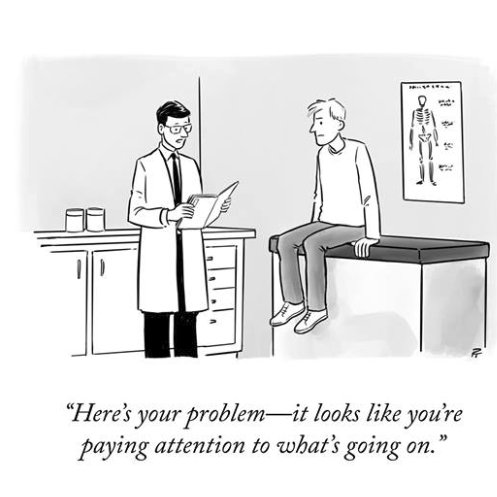
When we should be thinking about the way we support one another's lives and questioning the very assumption that there is a giant monolith called the economy that requires our commitment and our resources more than public health and individual well-being do, we are pouring unimaginable monetary and intellectual resources into trying to buy and sacrifice our way to the economic status quo ante. When it should be clearer than ever that we are only as well as our sickest member, we are allowing health care to continue to function as a business, with minimal intervention.
"When it should be clearer than ever that we are only as well as our sickest member, we are allowing health care to continue to function as a business, with minimal intervention." Chains are no stronger than their weakest links. https://t.co/Iq9mESRaG0 via @NewYorker
For 19 cents p/$1 more in taxes Danes get free health care & education, low poverty, homelessness, crime , inequality. They live two years longer than Americans. And they're the happiest people in the world. https://t.co/TBI1jr70J5
From The New York Times: A Young Doctor, Fighting for His Life “I just went down on my knees,” his mother recalled later. “I just implored God for mercy.” https://www.nytimes.com/2020/05/02/opinion/sunday/young-doctor-coronavirus.html?smid=em-share
Coronavirus as a Reminder of the Urgency of Getting Your Vaccines https://www.nytimes.com/2020/04/27/well/live/coronavirus-as-a-reminder-of-the-urgency-of-getting-your-vaccines.html?referringSource=articleShare
Top E.R. Doctor Who Treated Virus Patients Dies by Suicide https://www.nytimes.com/2020/04/27/nyregion/new-york-city-doctor-suicide-coronavirus.html?referringSource=articleShare
Hundreds of Miles From Home, Nurses Fight Coronavirus on New York's Front Lines https://www.nytimes.com/2020/04/28/nyregion/nurses-coronavirus.html?referringSource=articleShare
I Was Ready to Help Fight the Pandemic. Then I Got Sick Myself. https://www.nytimes.com/2020/04/24/magazine/surgeon-covid-diary.html?referringSource=articleShare
A new genetic engineering technology could help eliminate malaria and stave off extinctions — if humanity decides to unleash it.
One early summer evening in 2018, the biologist Anthony James drove from his office at the University of California, Irvine, to the headquarters of the Creative Artists Agency, a sleek glass-and-steel high-rise in Los Angeles. There, roughly 200 writers, directors and producers — many of them involved in the making of science-and-technology thrillers — were gathered for an event called Science Speed Dating, where James and other scientists would explain their work. The sessions were organized, James told me, “in hopes of getting the facts at least somewhat straight.”
Attendees were assigned to different groups, so each scientist had just seven minutes to describe his or her work to one group before running to the next room and starting over. “There were a lot of stairs, so I would get really out of breath,” James recalled. “I would arrive panting.” He also felt a bit overwhelmed. There were executives in expensive suits, young men and women looking unaccountably dressy in ripped jeans and, according to James, a disconcerting number of people wearing hats. Few, if any, had a deep knowledge of genetics; one participant in particular kept referring to “the dark genome,” as though that were a thing. “I had to tell him, ‘Real geneticists don’t usually talk that way,’ ” James said.
James began his presentation with a brief overview of mosquito-borne diseases like malaria and Zika. Then he turned cautiously to talking about his own area of scientific expertise: an obscure but powerful invention known as a gene drive. James began by noting that two brown-eyed human parents can sometimes produce a blue-eyed child, though only if both parents carry a copy of the recessive gene. A gene drive, he explained, was a tool that in some species could turn such events into a near certainty. For one thing, it guaranteed that a particular gene would be inherited, even if only one parent had it. And it would automatically insert the chosen gene into both copies of the offspring’s DNA, effectively turning a recessive trait into a dominant one. That alone, James explained, “lets you change the odds, so you get blue eyes 99 percent of the time.”
What made the gene drive truly strange and remarkable, though, was that it didn’t stop with one set of offspring. Generation after generation, it would relentlessly copy and paste the gene it carried, until it was present in every descendant. “For most of the people in the room, you could tell it was the first they’d heard of this,” James recalled. “You could see their eyes getting big.” (nyt mag, continues)
Comparing the dangerous effects of three diseases with the minimal side effects of their corresponding vaccines.
Vaccines prevent diseases, and being unvaccinated carries a risk. Last year, the World Health Organization ranked vaccine hesitancy, a “reluctance or refusal to vaccinate despite the availability of vaccines,” among the top 10 health threats worldwide, alongside Ebola, H.I.V. and drug-resistant infections.
To state it bluntly, being unvaccinated can result in illness or death. Vaccines, in contrast, are extremely unlikely to lead to side effects, even minor ones like fainting.
As vaccination rates have fallen, highly contagious illnesses like measles have resurged globally. For instance, measles is now widespread in several European countries. In Samoa, a Pacific island nation of about 200,000 people, almost 5,700 measles cases have been recorded since September, resulting in at least 83 deaths. Almost all of those who died were young children.
These deaths did not have to happen. In the United States, vaccine hesitancy is contributing to three public health threats: the return of measles, deaths from influenza and needless future cases of cervical cancer... (continues)
In 2015, an anti-vaccination campaign in Ireland caused a sudden fall in the uptake of the HPV vaccine. Then Laura Brennan got involved.
TRANSCRIPT
0:00/5:10
Terminally Ill at 25 and Fighting Fake News on Vaccines
We’ll need more than facts to fight medical misinformation
You all know about how fake news is threatening your democracy. But there’s another type of misinformation that’s threatening our very health. And this time, people are dying. I’m talking about medical misinformation. Roughly 49 percent of Americans believe in at least one medical conspiracy theory. When people are diagnosed, with cancer and they go online, they’re often hit with absolute falsehoods. These scare patients. And they either delay their conventional treatment or they sometimes reject it. My name is Dr. David Robert Grimes. I’m a cancer researcher. And when a vaccination confidence crisis came to Ireland, my home country, I found myself on the front line. Let me tell you about the human papilloma virus or H.P.V. Every year about 270,000 women die of cervical cancer caused by H.P.V. infection. But for the first time in our history, we now have a vaccine that prevents against it. It’s difficult to overstate how effective this vaccine has been. In America, H.P.V. infection in young girls has dropped about 88 percent. But then things changed. In Japan in 2013, sustained anti-vaccine activism led to a panic, which saw vaccination rates for H.P.V. dropped from 70 percent to less than 1 percent within a year or two. In 2014, a similar outbreak of panic came to Denmark. In the U.S.A., H.P.V. vaccination rates in adolescence remain critically low, hovering at around 16 percent. “The uptake rate for the H.P.V. vaccine has dropped.” In 2015, panic about the H.P.V. vaccine came to Ireland. “For some girls and young women, the side effects of Gardasil go well beyond a few months.” I couldn’t believe that I was hearing, such dangerous falsehoods about a vaccine that prevents 5 percent of all cancers. “We only ever wanted what was best for our girls.” Within a year or so, Irish vaccination rates had gone from highs of 87 percent to about 50 percent. It starts with this: As rational as we like to think we are, and as logical, the truth is that we emote first and we reason later. “And I watched my baby go boom and hit the ground.” You’ll often see a scare story that says — particularly a teenage girl — has had an adverse effect to this vaccination. “I believe with all my heart that the Gardasil vaccination did this to her.” And it’ll be delivered in a very frightening way that captures your attention. “I was such an intelligent girl and now I’ve just got this fog over my mind.” It doesn’t matter that the stories lack any veracity. What matters is they scare us and in scaring us we remember them. And in remembering them, we afford them more weight than they deserve. And so starts a vicious cycle. This explains why lies about the H.P.V. vaccine were able to do so much damage in so many countries. But in Ireland, what really changed the situation was a woman called Laura Brennan. When Laura was 24, she was diagnosed with cervical cancer, and by the time she was 25, that was metastatic noncurable. Laura was alarmed that people weren‘t getting this vaccine that could prevent women from being in the situation that she found herself in. Her campaigning started with a series of advertisements where she talked to parents directly to them. “Protect our future.” She was on talk shows. She was interviewed in magazines. “If anything good comes out of this, I would hope parents would get their daughters vaccinated. The vaccine saves lives. It could have saved mine.” She said, I am the reality of an unvaccinated girl. “So it just shows you how fast and aggressive my cancer is. But yeah, that’s life.” It’s no good just throwing facts of people until you can show them why those facts matter. In Ireland, thanks in large part to her campaigning, rates climbed back up over 70 percent, and are continuing to climb. It shows that you can reverse some of this damage. “When I found out that my cancer was terminal, I wanted to use my voice for good, and for the last 12 months, I haven’t shut up.” Laura exemplified something really, really important: That you never change minds without changing hearts as well. All the journal articles in the world, all the physicians and scientists in the world, saying something is for nothing if you can’t reach people on a visceral emotional level and show them why something matters. I was incredibly honored and privileged to be close to Laura Brennan. She passed away on the 20th of March 2019, aged only 26. But she leaves behind a legacy that will extend far beyond most of our lifetimes. And she will save more lives than a library of journal articles and scientific experts in isolation could ever hope to achieve. And that’s some legacy to leave behind.
00:00
5:09
5:09Terminally Ill at 25 and Fighting Fake News on Vaccines
We’ll need more than facts to fight medical misinformationCreditCredit...RTÉ TelevisionBy David Robert Grimes Dec. 11, 2019 Video by Adam Westbrook
In 2019, measles cases in the U.S. have been on the rise, much of it driven by false claims about the safety of the vaccine.
In the Video Op-Ed above, a cancer researcher, David Robert Grimes, confronts the rising trend of medical misinformation. From herbal remedies for cancer to vaccination horror stories, fake medical news is spreading fast on social media.
The effects can be severe, with anti-vaccination movements partly responsible for the resurgence of measles and other preventable illnesses.
In 2015, an anti-vaccination campaign in Ireland caused a sudden fall in the number of HPV vaccines administered, given to young girls and boys to prevent cervical cancer. Dr. Grimes tells the story of how, with the help of a remarkable woman named Laura Brennan, they were able to reverse the trend, and what countries like the United States can learn in their fight against medical misinformation.
David Robert Grimes (@drg1985), a cancer researcher and physicist, is author of “The Irrational Ape: Why Flawed Logic Puts Us All at Risk and How Critical Thinking Can Save the World.”
Ethics is a more inclusive matter than morality; it concerns character whereas morality concerns actions. Our actions will mainly of course flow from our character, but the targets of enquiry in ethics (seeking answers to What sort of person shall I be?) and in debates about morality (What is the right thing to do in this case?) are obviously not the same... A.C. Grayling, The History of Philosophy
In 1920s America, a mix of nativist sentiment and pseudoscience led to the first major law curtailing immigration. Okrent focuses on eugenics, which argued that letting in people of certain nationalities and races would harm America’s gene pool...
Written before her death last year from cancer at the age of 42, Yip-Williams’s book is a remarkable woman’s moving exhortation to the living.
== ‘THE UNDYING: Pain, Vulnerability, Mortality, Medicine, Art, Time, Dreams, Data, Exhaustion, Cancer, and Care’ By Anne Boyer (Farrar, Straus & Giroux). Boyer’s extraordinary and furious book is partly a memoir of her illness, diagnosed five years ago; she was 41 when she learned that the lump in her breast was triple-negative cancer, one of the deadliest kinds. But her story, told with searing specificity, is just one narrative thread in a book that reflects on the possibility — or necessity — of finding common cause in individual suffering.
Much of what we accept as legal in medical billing would be regarded as fraud in any other sector.
I have been circling around this conclusion for this past five years, as I’ve listened to patients’ stories while covering health care as a journalist and author. Now, after a summer of firsthand experience — my husband was in a bike crash in July — it’s time to call out this fact head-on. Many of the Democratic candidates are talking about practical fixes for our high-priced health care system, and some legislated or regulated solutions to the maddening world of medical billing would be welcome.
My husband, Andrej, flew over his bicycle’s handlebars when he hit a pothole at high speed on a Sunday ride in Washington. He was unconscious and lying on the pavement when I caught up with him minutes later. The result: six broken ribs, a collapsed lung, a broken finger, a broken collarbone and a broken shoulder blade.
The treatment he got via paramedics and in the emergency room and intensive care unit were great. The troubles began, as I knew they would, when the bills started arriving.
I will not even complain here about some of the crazy high charges: $182 for a basic blood test, $9,289 for two days in a room in intensive care, $20 for a pill that costs pennies at a pharmacy. We have great insurance, which negotiates these rates down. And at least Andrej got and benefited from those services... (continues)